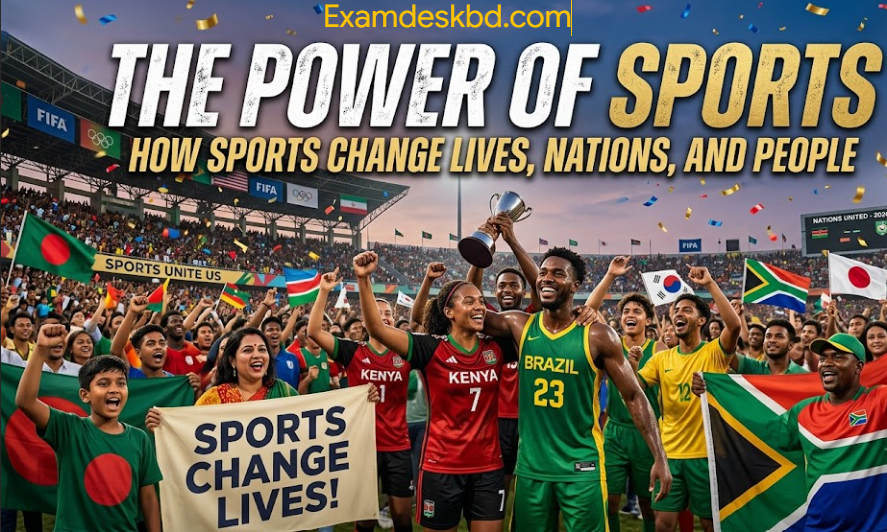
How Sports Has the Power to Change Lives ?
Introduction: More Than a Game
Sports evoke profound human emotions, uniting crowds in shared experiences of passion and pride. Often regarded merely as entertainment, they play a significant role in civilization by building character, fostering community, and driving economies. Sports impart valuable life lessons and create unforgettable moments of joy and heartbreak, impacting all aspects of human existence beyond mere scores.
The History of Sports: As Old as Civilization Itself
Sports have ancient origins, with the earliest recorded athletic competition in Sumer around 3000 BCE. The Greeks formalized athletics with the Olympic Games, starting in 776 BCE, valuing both intellectual and physical excellence. The term “gymnasium” reflects their practice of training naked, celebrating the human form. Romans focused on gladiatorial combat and chariot racing, while medieval Europe introduced jousting and archery. Indigenous cultures worldwide developed diverse sports like lacrosse and wrestling, illustrating the universal human inclination towards physical competition.
The Physical Benefits: Building the Body
The most visible benefit of sports is physical. Regular participation in athletic activity strengthens the cardiovascular system, builds muscular strength and endurance, improves flexibility, and helps maintain healthy body weight. According to the World Health Organization, physical inactivity is now one of the leading risk factors for global mortality, contributing to conditions including heart disease, diabetes, hypertension, and certain cancers.
Sports make movement enjoyable in a way that going to the gym alone often cannot. When a child chases a ball down a field, she is not thinking about burning calories or strengthening her cardiovascular system — she is having fun. But the biological benefits are accumulating with every sprint. This is one of the great gifts of sport: it makes healthy behavior feel like pleasure rather than obligation.
For young people especially, establishing an active lifestyle through sports creates habits that last a lifetime. Children who participate in organized sports are more likely to remain physically active as adults, more likely to make healthier nutritional choices, and statistically less likely to develop chronic diseases later in life. Investment in youth sports programs is, in this sense, an investment in public health.
The Mental and Emotional Benefits: Building the Mind
What sports do to the mind is just as significant as what they do to the body. Physical activity triggers the release of endorphins, serotonin, and dopamine — the brain’s natural mood-elevating chemicals. Regular sporting activity is now strongly supported by clinical evidence as an effective treatment for mild to moderate depression and anxiety. Exercise reduces cortisol, the hormone associated with chronic stress, and promotes neuroplasticity — the brain’s ability to form new connections and adapt.
Beyond the biochemical, sports teach emotional lessons that are difficult to replicate in any classroom. They teach resilience — the ability to absorb failure and come back stronger. Every athlete who has ever trained for months and lost a final, or missed the crucial penalty, or fallen at the last hurdle, has been given an education in how to handle defeat with dignity. These lessons do not stay on the field. They transfer directly to how a person handles setbacks in their career, their relationships, and their personal life.
Sports teach discipline. No elite athlete wakes up at 5 AM to train because they feel like it every single day. They do it because they have built systems of self-regulation, goal-setting, and delayed gratification — skills that form the psychological foundation of success in any domain. Sports teach focus: the ability to concentrate under pressure, to block out noise, to be fully present in a critical moment. And sports teach teamwork — perhaps the most valuable professional skill of the modern era.
Sports and Society: The Unifying Force
Few things have the power to unite people across the fault lines of language, religion, ethnicity, and class quite like sport. When a national team takes the field, millions of people who might otherwise have nothing in common stand behind a shared identity. This is not nationalism in a dangerous sense — it is the more benign and beautiful experience of collective belonging, of being part of something larger than yourself.
Some of the most powerful moments in the history of social progress have come through sport. Jesse Owens’ four gold medals at the 1936 Berlin Olympics delivered a stunning rebuke to Nazi racial ideology before a global audience. Muhammad Ali’s refusal of military conscription made him the most visible symbol of anti-war resistance in America. Billie Jean King’s victory over Bobby Riggs in the 1973 “Battle of the Sexes” became a defining moment in the women’s liberation movement. Cathy Freeman carrying both the Australian and Aboriginal flags after winning gold at the 2000 Sydney Olympics gave a nation a moment to confront its own history. These were not just sporting events — they were turning points in the story of human rights.
Sport also bridges economic divides. A football pitch requires little more than open ground and a ball — the most democratic of surfaces. The greatest football players in the world grew up in poverty in Brazil, Argentina, Senegal, and Ghana, where sport was not just recreation but the most available and most visible ladder out of disadvantage. This is why sports hold such profound hope in communities with limited economic mobility — because talent and hard work, on a level playing field, can genuinely win.
Sports as a Global Industry
Modern professional sport is also a colossal economic engine. The global sports industry — encompassing television broadcast rights, sponsorships, merchandise, ticketing, stadium infrastructure, and digital media — is worth hundreds of billions of dollars annually. Major sporting events such as the FIFA World Cup, the Olympic Games, and the ICC Cricket World Cup generate revenues that dwarf the GDP of many small nations.
Elite athletes today operate as global brands. The wages paid to top footballers, basketball players, cricketers, and tennis stars are almost incomprehensible by ordinary standards — a reflection of the enormous media and commercial value they generate. Sports journalism, sports medicine, sports psychology, stadium architecture, sports nutrition, and sports analytics have all become flourishing professional fields in their own right.
Behind the glittering surface of professional sport, however, serious questions of governance, corruption, doping, player welfare, and the environmental footprint of mass sporting events require honest attention. The fact that sport matters so much — economically and emotionally — makes it all the more important that it is administered with integrity and held to the highest ethical standards.
Women in Sport: A Revolution Still in Progress
For much of human history, sport was considered a male domain. Women were excluded from the ancient Olympics entirely. Even in modern history, women were barred from many events — women were not permitted to run the Olympic marathon until 1984. The transformation of women’s sport over the past five decades has been one of the most significant social revolutions of the modern era.
Today, women’s cricket, women’s football, women’s tennis, women’s basketball, and women’s athletics command global audiences and generate substantial commercial revenues. Athletes like Serena Williams, Marta, Mithali Raj, Simone Biles, and Elaine Thompson-Herah have become icons whose influence extends far beyond their sport. Yet significant gaps in pay, media coverage, and investment between men’s and women’s sport persist in most disciplines — a reminder that the revolution, though real, remains incomplete.
Conclusion: Sports as a Mirror of Humanity
Sport holds up a mirror to humanity. In its finest moments — a perfect team performance, a champion helping a fallen competitor across the finish line, rivals embracing after a hard-fought match — sport reflects the very best of what people can be: generous, courageous, disciplined, joyful, and united. In its worst moments — doping scandals, match-fixing, fan violence, discrimination — it reflects the same flaws that exist everywhere in human society.
This is precisely why sport matters so deeply. It is not separate from life — it is life, compressed into a finite arena with clear rules and a ticking clock. It teaches us how to compete and how to cooperate. How to win with humility and lose with grace. How to push beyond what we thought possible, and how to stand up again after falling. These are not lessons about sport. They are lessons about being human. And that is why, as long as there are human beings on this earth, there will be sport.