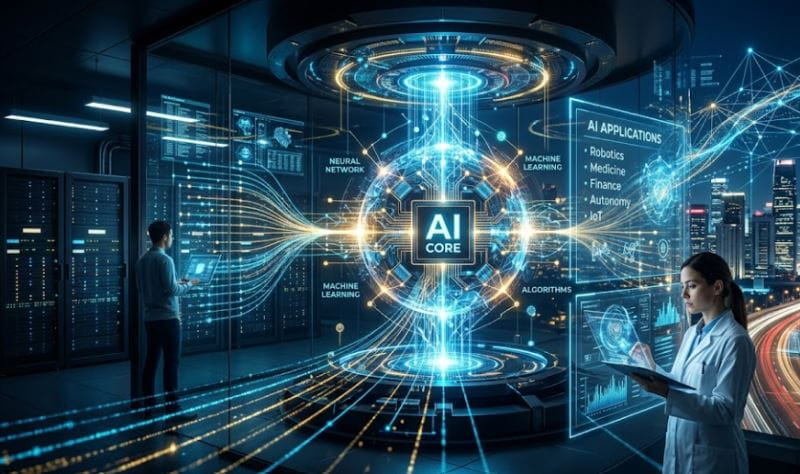
Artificial Intelligence : The Journey, Present, and Future
Introduction
Artificial Intelligence (AI) is one of the most transformative technologies of our time. This branch of computer science is concerned with creating intelligent machines that can perform tasks that would normally require human intelligence—such as understanding natural language, recognizing images, and making decisions. The world we live in today is awash with amazing technology that enables us to create everything from recipes to Mars experiences at the click of a button.
Artificial intelligence has made incredible strides in the past few decades. Powerful new computing networks, vast amounts of training data, and advanced AI techniques have led to systems that can perform fluent conversations, advanced scientific reasoning, software development, and highly realistic images, audio, and video. AI is no longer just a lab thing; it is now an integral part of our daily lives—from smartphone virtual assistants to self-driving cars, from recommendation systems to medical diagnosis.
In this article, we will discuss in detail the history of artificial intelligence, its current status, social impact, ethical challenges and future prospects.
1. History of Artificial Intelligence: A Brief Tour
1.1. Introduction: Turing and the Dartmouth Conference
The concept of artificial intelligence predates computers. Eighteenth-century philosophers theorized about the nature of intelligence and the possibility of intelligence beyond the human brain. However, the modern journey of AI began in 1950, when Alan Turing proposed the Turing Test in his article “Computing Machinery and Intelligence”. This test essentially tests the ability of a machine to exhibit intelligent behavior.
The term artificial intelligence was coined in 1956. John McCarthy, Marvin Minsky, Nathaniel Rochester and Claude Shannon organized a conference at Dartmouth College and first used the term. This conference is considered the official birth of AI. McCarthy deliberately chose the name “artificial intelligence” because he did not want to be confined to narrow disciplines such as automata theory or cybernetics.
1.2. Early successes: Logic Theorists and ELIZA
In 1956, before the Dartmouth conference, Allen Newell, Herbert Simon, and Cliff Shaw created the Logic Theorist program, often called “the first artificially intelligent program.” It was able to prove mathematical theorems from the Principia Mathematica. Interestingly, the first version of this was simulated manually—the program was handwritten on cards, and Simon’s wife and children played the roles of parts of the program by holding the cards.
In the 1960s, Joseph Weizenbaum created a computer program called ELIZA, which was the first chatbot. Eliza could converse with humans, which was a breakthrough for the time. At the same time, Daniel Bobrow created an NLP program called STUDENT that could solve algebraic word problems.
1.3. The Winter of AI
In the 1970s, AI research did not progress as expected. In 1969, Marvin Minsky and Seymour Papert published the book “Perceptrons”, in which they highlighted the limitations of single-layer perceptrons. This book somewhat stagnated neural network research, as they showed that perceptrons could not solve complex problems such as XOR gates. This period is called the “winter” of AI, when both funding and interest waned.
However, Minsky and Papert mainly discussed the limitations of single-layer perceptrons, and they did not research multi-layer networks. Technological advances and research in the 1980s and 1990s led to a growing understanding of the potential of multi-layer perceptrons and the ability to overcome these limitations.
2. Modern AI: Revival and Advances
2.1. Machine Learning and Deep Learning
The late 20th and early 21st centuries saw a renaissance in AI with machine learning (ML) and deep learning. Machine learning is the process of learning from data using statistical algorithms, enabling AI models to learn from data on their own. Deep learning is a method of training AI models using neural networks, inspired by the human or animal brain and biological neural networks.
Important milestones include:
1997: IBM’s Deep Blue defeats Garry Kasparov at chess—the first time an AI has defeated a world champion.
2011: Apple launches Siri, which acts as a voice-activated personal assistant.
2012: AlexNet proves the superiority of deep learning in image recognition.
2016: Google’s AlphaGo beats world champion Lee Sedol, demonstrating the incredible skill of AI in the game of Go.
2016: Facebook launches DeepFace, which can recognize human faces in photos.
2.2. Generative AI and Large Language Models
The biggest advancement in recent years has been generative AI and large language models (LLM). In 2018, OpenAI released GPT (Generative Pre-trained Transformer) and in November 2022, ChatGPT was released, which caused a stir worldwide.
These models are based on the Transformer architecture, which is capable of performing various tasks after being pre-trained on large amounts of text data—the
