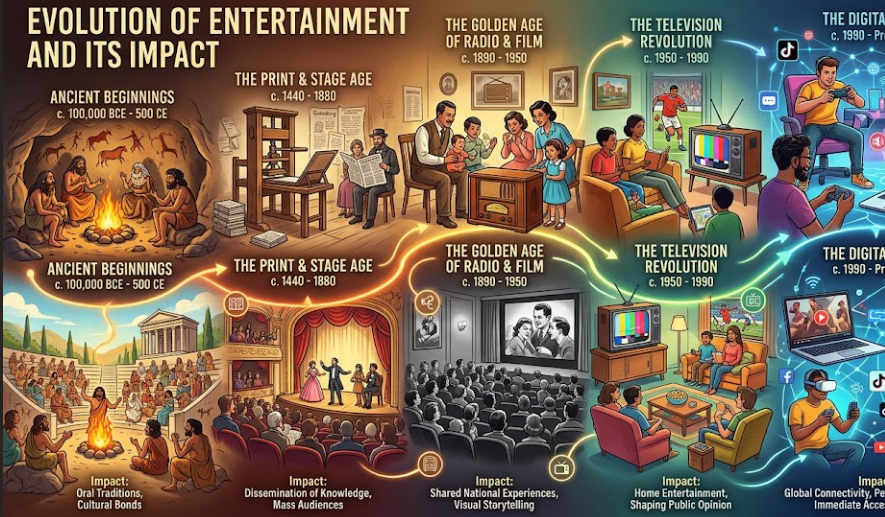
The Evolution of Entertainment and Its Impact in the world.
Entertainment has been an integral part of human existence since the dawn of civilization. It serves as a mirror reflecting our values, aspirations, and collective consciousness. Throughout history, the ways we amuse ourselves have evolved dramatically, transforming from simple oral traditions to the complex, multi-sensory experiences of today’s digital age. This journey through entertainment not only tells the story of technological advancement but also reveals the fundamental human need for connection, escape, and meaning.
The Ancient Roots of Entertainment
Long before Netflix or TikTok, our ancestors gathered around campfires to share stories. These early forms of entertainment were deeply intertwined with survival, education, and spiritual practice. Cave paintings in Lascaux, France, dating back 17,000 years, depict more than just animals—they tell stories, capture moments of triumph, and preserve cultural memory. Oral traditions, passed down through generations, served as both entertainment and historical record, keeping communities connected to their past.
The ancient Greeks elevated entertainment to new heights with the invention of theater. The dramatic festivals of Athens, particularly the City Dionysia, transformed storytelling into a structured art form. Playwrights like Sophocles, Euripides, and Aristophanes explored the depths of human emotion, politics, and morality through tragedy and comedy. These performances were not merely passive consumption but active civic participation, where thousands of citizens would gather in amphitheaters to witness and reflect upon the human condition.
Similarly, the Romans developed spectacular forms of entertainment that demonstrated their engineering prowess and social hierarchy. The Colosseum’s gladiatorial contests, chariot races at the Circus Maximus, and elaborate naval battles staged in flooded arenas were designed to awe and control the masses. While brutal by modern standards, these spectacles represented the pinnacle of organized entertainment for centuries.
The Printing Press and the Birth of Mass Entertainment
The invention of the printing press by Johannes Gutenberg in the 1440s marked a watershed moment in entertainment history. For the first time, stories could be reproduced and distributed on a scale previously unimaginable. Books, pamphlets, and newspapers became accessible to growing segments of the population, creating shared cultural experiences across geographical boundaries.
The rise of the novel in the 18th century democratized entertainment further. Works like Daniel Defoe’s “Robinson Crusoe” and Samuel Richardson’s “Pamela” captivated readers across social classes. The serialized novels of Charles Dickens in the 19th century created a phenomenon akin to modern binge-watching, with readers eagerly awaiting each new installment. This period also saw the emergence of public libraries, making entertainment available to those who could not afford to purchase books.
The Victorian era witnessed the golden age of theater in the English-speaking world, with playwrights like Oscar Wilde and Henrik Ibsen pushing boundaries of social commentary. Music halls and vaudeville theaters provided accessible entertainment for the working classes, featuring a mix of comedy, song, and spectacle that would later influence cinema and television.
The Dawn of Recorded Entertainment
The late 19th and early 20th centuries brought revolutionary changes with the development of recorded sound and motion pictures. Thomas Edison’s phonograph (1877) and the Lumière brothers’ cinematograph (1895) created entirely new mediums for entertainment. For the first time, performances could be preserved, replicated, and distributed far beyond the capabilities of live performance.
The film industry grew rapidly, with Hollywood emerging as the global center of movie production. Silent films gave way to “talkies” with the release of “The Jazz Singer” in 1927, and color films followed in the 1930s. Movie palaces became temples of entertainment, offering escape from the hardships of the Great Depression and the traumas of world wars. Stars like Charlie Chaplin, Greta Garbo, and Clark Gable became household names, their images and performances creating a new form of celebrity culture.
Radio broadcasting transformed entertainment consumption between the 1920s and 1950s. Families gathered around the radio for news, dramas, comedies, and music, creating shared national experiences. The radio brought diverse entertainment directly into homes, breaking down regional barriers and creating a more unified popular culture. Programs like “The Shadow,” “Fibber McGee and Molly,” and the broadcasts of big band music defined the entertainment landscape of the era.
The Television Revolution
Television’s mass adoption after World War II fundamentally restructured entertainment consumption. The 1950s saw television sets become fixtures in American and European homes, changing family dynamics and social interactions. The evening news brought world events into living rooms, while sitcoms like “I Love Lucy” and variety shows like “The Ed Sullivan Show” became cultural touchstones.
Television created a new kind of intimacy with entertainers. Unlike film stars who seemed distant and glamorous, television personalities felt like familiar companions. The medium’s reach was unprecedented—millions could simultaneously experience the same moments, from the moon landing to the Beatles’ first appearance on American television.
The proliferation of cable television in the 1980s and 1990s fragmented the audience again. Channels specialized in news, sports, music, and various niche interests, allowing viewers to curate their entertainment experiences. MTV transformed the music industry, creating a visual component that became essential to artistic expression. HBO and other premium channels pushed boundaries with adult-oriented content, paving the way for the “Golden Age of Television” that would follow.
The Digital Revolution and Streaming Era
The internet has perhaps brought the most dramatic transformation in entertainment history. The digitization of content, combined with increasing bandwidth and mobile devices, has created unprecedented access to entertainment. Services like Netflix, Spotify, and YouTube have essentially unlimited libraries available on demand, fundamentally changing consumption patterns.
Streaming has broken the tyranny of schedules. Binge-watching entire seasons of shows in a single weekend has become common practice, altering the rhythm of storytelling and cultural conversation. The “water cooler moment” of discussing last night’s episode has been replaced by the challenge of avoiding spoilers until everyone has caught up.
The democratization of content creation represents another paradigm shift. Platforms like YouTube, TikTok, and Twitch allow anyone with a smartphone to become an entertainer. This has led to the explosion of influencer culture, where individuals can build massive followings without traditional gatekeepers. This democratization has its shadow side as well, including issues of quality control, misinformation, and the sometimes toxic nature of internet fame.
The Experience Economy and Immersive Entertainment
As digital entertainment saturates our lives, there has been a countermovement toward physical, shared experiences. The “experience economy” has seen concerts, festivals, and live events reach unprecedented popularity. Music festivals like Coachella and Glastonbury are not just musical events but cultural phenomena combining art, fashion, and community.
Escape rooms, immersive theater, and pop-up experiences offer forms of entertainment that cannot be replicated on screens. The success of projects like “Sleep No More” in New York and London suggests a hunger for participatory, sensory-rich experiences that our digital lives often lack.
Video games have evolved from simple diversions to complex narrative experiences and professional sports. The esports industry generates billions in revenue, with professional gamers achieving celebrity status. Games like “Fortnite” have become social platforms where millions gather for virtual concerts and events, blurring the lines between gaming and social media.
The Future of Entertainment
Looking forward, emerging technologies promise to reshape entertainment once again. Virtual and augmented reality could create entirely new immersive experiences, allowing users to step into their favorite stories. Artificial intelligence might generate personalized content, creating movies or music tailored to individual preferences.
The metaverse concept suggests a convergence of digital and physical entertainment, where users maintain persistent identities across gaming, socializing, and work. Whether this vision becomes reality or remains a marketing buzzword remains to be seen, but it indicates the direction of industry thinking.
Sustainability concerns will likely influence the future of entertainment as well. Large-scale productions, international travel for filming, and the energy consumption of streaming data centers face increasing scrutiny. The industry will need to balance creativity with environmental responsibility.
Conclusion
Throughout history, entertainment has reflected humanity’s technological capabilities and deepest needs. From the earliest stories told around fires to the immersive digital experiences of today, entertainment serves fundamental purposes: connecting us to each other, helping us make sense of our world, and providing escape from its pressures.
As we navigate an increasingly complex media landscape, the challenge is to find balance. The abundance of choice can be overwhelming, and the algorithms designed to serve us may instead create echo chambers. Yet the power of entertainment to educate, inspire, and bring joy remains undiminished. The future will undoubtedly bring innovations we cannot yet imagine, but the human desire for stories, connection, and wonder will continue to drive entertainment’s evolution. In the end, entertainment is not merely a pastime but a vital expression of what it means to be human.
